

Shrimp farming is one of the fastest-growing sectors in global aquaculture, but disease outbreaks remain a major challenge. To reduce these risks, chlorine-based disinfectants play a crucial role in shrimp farming.
Why Is Biosecurity Important in Shrimp Farming?
Disease outbreaks are one of the major causes of economic losses in shrimp farming. Shrimp are highly sensitive to environmental changes, and poor farming conditions can weaken their immune systems, making them more susceptible to pathogens. Common Shrimp Species and Examples of Their Common Diseases:
White Spot Syndrome (WSS)
White Spot Syndrome, which primarily affects white leg shrimp populations, is caused by infection with the White Spot Syndrome Virus (WSSV). This virus is highly contagious, has a high mortality rate, and is widespread.
Iris Virus Infection (SHIV)
It is a virus found in nearly all common shrimp species. These include the white shrimp (Penaeus vannamei), the spot shrimp (P. japonicus), the Chinese shrimp (P. chinensis), the Australian freshwater crayfish (Cherax quadricarinatus); the American crayfish (Procambarus clarkii); Japanese swamp shrimp (Macrobrachium nipponense), and Thai shrimp (Macrobrachium rosenbergii.
Early Mortality Syndrome (EMS/AHPND)
Early Mortality Syndrome, also known as Acute Hepatopancreatic Necrosis Disease, is primarily caused by pathogenic Vibrio bacteria. This disease typically occurs during the early stages of cultivation and can result in mass mortality within a short period.
Since many pathogens can be transmitted through water and contaminated surfaces, scientific hygiene management and disinfection measures are particularly important for disease prevention. The use of chlorine-based disinfectants for pond cleaning and water treatment during the middle and late stages of shrimp farming can largely prevent these viruses and reduce losses.
Common Chlorine-Based Disinfectants Used in Aquaculture
Chlorine-based disinfectants are those that, when dissolved in water, produce hypochlorous acid, which possesses antimicrobial activity. Their active ingredient is expressed as available chlorine. The most common chlorine-based disinfectants used in shrimp farming are bleaching powder, sodium dichloroisocyanurate, and trichloroisocyanurate. Taking Chinese shrimp as an example:
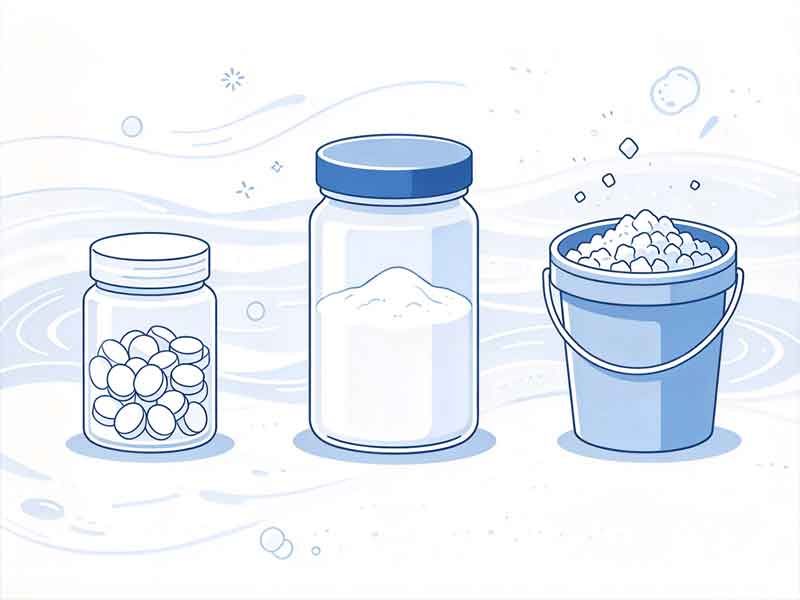
Calcium Hypochlorite (Cal Hypo, CHC)
Calcium Hypochlorite typically appears as white granules or tablets. However, due to the presence of transition metal impurities, it is usually pale green, grayish-white, pink, orpale yellow in color. It is available in two specifications: 65% and 70% available chlorine. We can customize product specifications to meet your specific needs.
Usage and Dosage: The recommended dosage for disinfecting shrimp ponds is 20 grams per cubic meter of water; for disease prevention in aquaculture ponds, the dosage is 0.4–0.8 grams per cubic meter of water. Apply evenly throughout the pond approximately once a week to treat red leg disease caused by Vibrio parahaemolyticus in shrimp.
Sodium Dichloroisocyanurate (SDIC)
Sodium Dichloroisocyanurate is typically available in the form of white powder, granules, or tablets. It has an active chlorine content of 60%. As a stable chlorine-based disinfectant, it continuously releases hypochlorous acid. It exhibits strong bactericidal activity against bacterial vegetative cells, spores, viruses, and fungal spores, and also serves to kill algae, eliminate odors, and purify water quality.
Usage and Dosage: For immersion baths, use 1 mg/L for 15–20 minutes. For prevention, broadcast 0.045–0.075 g/m³ throughout the pool. For treatment, broadcast 0.15–0.30 g/m³ throughout the pool and continue for 3–4 days.
Trichloroisocyanuric Acid (TCCA)
Trichloroisocyanuric Acid is generally available in the form of white powder, granules, or tablets. It contains 90% available chlorine.
Usage and Dosage: For prevention, broadcast 0.15–0.2 g/m³ throughout the entire pool once daily for 3 consecutive days. Repeat the treatment after 15 days. For treatment, broadcast 0.3–0.375 g/m³ throughout the pond once daily for 2–3 consecutive days.
Important Notice: Please note the above dosage recommendations are for reference only. Actual dosage should be determined based on the species of shrimp and water conditions. Take Chinese shrimp as an example. The safe concentration of chlorine for spot prawns, giant river prawns, and Van’s shrimp is much lower.
Warning: Do not use under conditions of oxygen deficiency, before or after fish come to the surface, or during abnormal weather conditions.
How Are Chlorine-Based Disinfectants Used in Shrimp Farming?
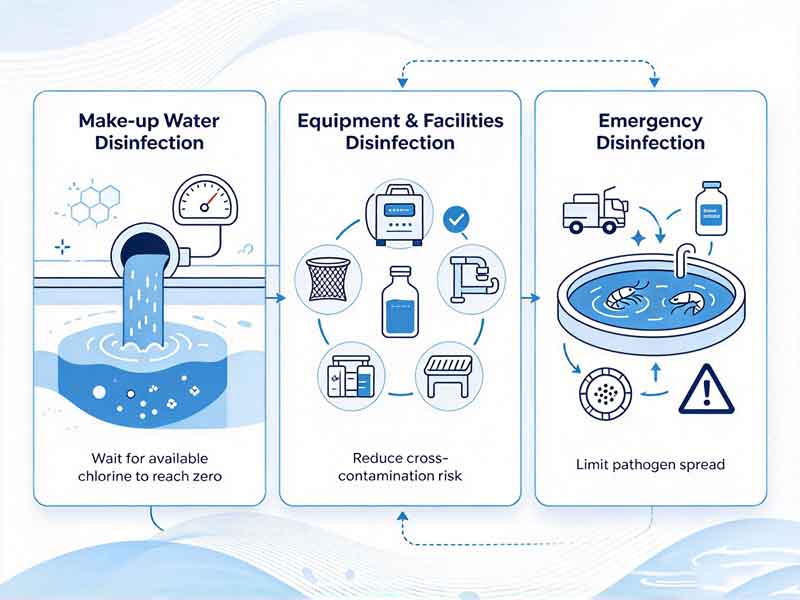
- Water Disinfection: Throughout the entire farming cycle, shrimp ponds require water replenishment. At this time, disinfectants must be used to disinfect the replenishment water. It is important to note that this disinfected water should only be introduced into the shrimp pond once the available chlorine concentration has dropped to zero.
- Disinfection of Equipment and Facilities: Equipment such as aerators, nets, pipes, troughs, and feeding tools can easily become sources of cross-contamination if not disinfected regularly. Regular hygiene management helps reduce the risk of disease transmission.
- Control Following a Disease Outbreak: When a disease outbreak occurs, prompt implementation of emergency disinfection measures helps limit the spread of pathogens and minimize losses.
We have experience with all three of the above chlorine-based products. We are committed to providing you with high-quality, reliable products, and our company values long-term partnerships. Therefore, the quality of our products is guaranteed. Our products have also passed various international tests, and we can provide you with the relevant certificates upon request.
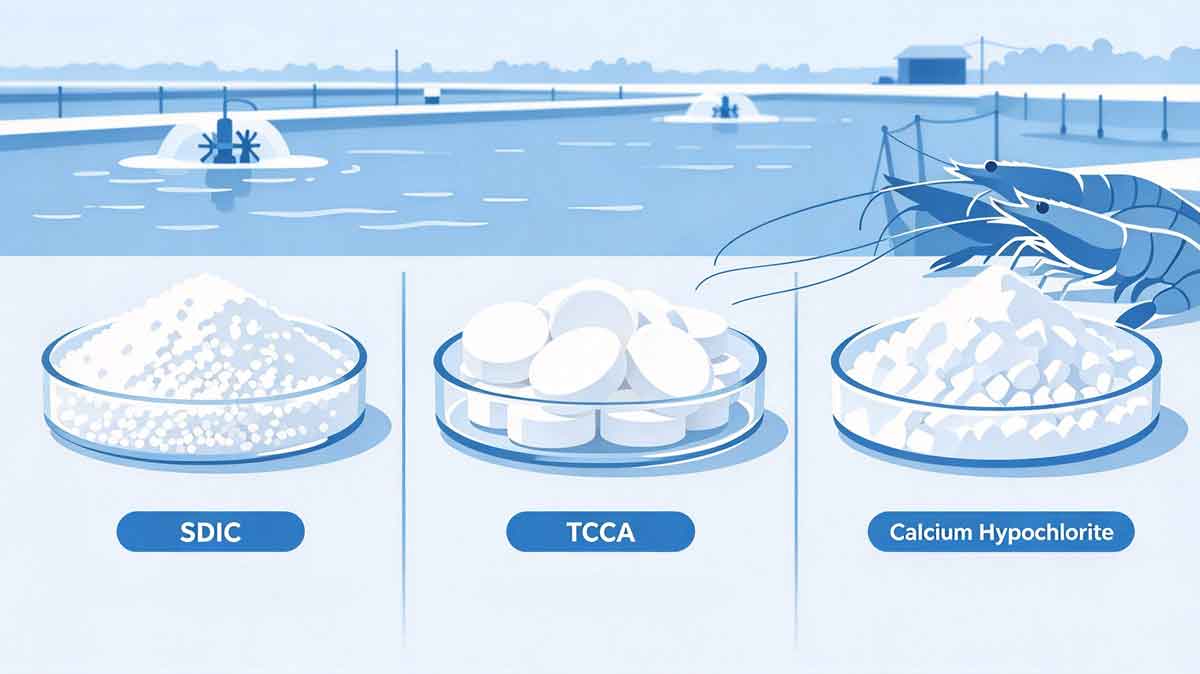
SDIC vs. TCCA vs. Calcium Hypochlorite in Shrimp Farming
All three chlorine-based disinfectants are highly effective at killing bacteria, are suitable for a wide range of bacterial strains, and have a broad scope of application. However, there are subtle differences among them, which are outlined below for your reference:
- Calcium hypochlorite: CHC is the most expensive, but it has the widest range of applications.
- SDIC/TCCA: If you practice intensive farming and are looking for a disinfectant that provides long-term, stable disinfection results, please consider these two options. Both of these options offer great value for the price.
Looking for Chlorine-Based Disinfectants for Aquaculture?
Choosing the right disinfectant depends on the intended application, available chlorine content, water conditions, and local aquaculture requirements. Yuncang supplies water treatment chemicals, including Sodium Dichloroisocyanurate (SDIC), Trichloroisocyanuric Acid(TCCA), and Calcium Hypochlorite for suitable applications.
Contact our team to discuss product specifications, packaging options, and supply requirements for your market.
Post time: Oct-19-2026


