

⚡Quick Answer
To raise chlorine levels in a swimming pool, you typically add about 21.5 g of 70% calcium hypochlorite per 10 m3 of water to increase free chlorine by 1.5 ppm (1 mg/L).
This dosage applies to 70% available chlorine Calcium Hypochlorite, one of the most common disinfectants used in swimming pool water treatment.
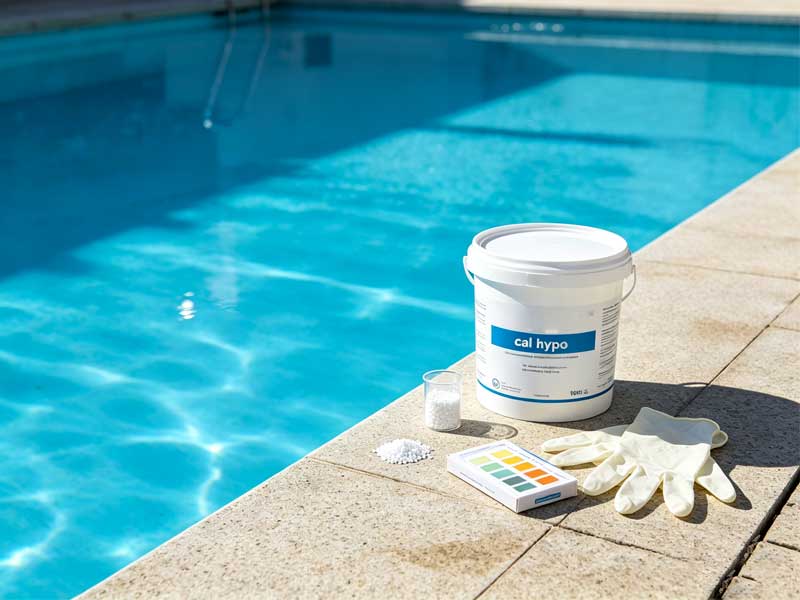
Swimming Pool Disinfection is essential for maintaining clean, clear, and safe water. Among the many disinfectants available, Calcium Hypochlorite is one of the most widely used due to its strong oxidizing power, high available chlorine content, and excellent disinfection performance.Calcium Hypochlorite, often abbreviated as Cal Hypo, is a powerful chlorine-based disinfectant widely used in swimming pools, drinking water treatment, and industrial water disinfection. It typically contains 65%–70% available chlorine, making it a highly concentrated chlorine source.However, many pool owners, maintenance professionals, and water treatment operators often ask the same question: How much calcium hypochlorite should be added to a pool? Adding too little may lead to poor sanitation and algae growth, while adding too much may cause irritation, high chlorine levels, and unnecessary chemical consumption.
In This Guide
- How it works in pool water
- The correct dosage for different situations
- Factors that influence the required amount
- Step-by-step dosing calculation
- Best practices for safe and efficient application
ⓘ This article will help pool operators and distributors understand how to correctly apply calcium hypochlorite for optimal pool water treatment.
Why Correct Pool Chlorine Levels Matter?
In routine maintenance, the main function of calcium hypochlorite in swimming pools is to maintain an appropriate level of free chlorine. Free chlorine is responsible for killing harmful microorganisms and oxidizing organic pollutants. The free chlorine content is a key indicator of water quality and its disinfection effectiveness.
When the free chlorine content in a pool is too low, its disinfection ability will significantly decrease, leading to the following problems:
- Insufficient disinfection, reducing the hygiene and safety of the pool water. Swimmers may face an infection risk.
- Increased algae growth, causing the pool water to turn green, reducing water transparency, and producing unpleasant odors. This not only affects the pool's aesthetics but also increases subsequent treatment costs.
When the free chlorine content in a pool is too high, it can also have adverse effects:
- Irritation to the human bodyFor example: stinging eyes, dry or itchy skin, dry hair, etc.The effects are more pronounced for children or people with sensitive skin.
- Corrosion of pool equipment
- Affecting swimwear and pool materials
To avoid these problems, we need to pay close attention to the free chlorine content of swimming pools.
Recommended chlorine levels for pools
Typically, we keep the free chlorine level in swimming pools between 1-3 ppm. In public pools or those used frequently, the free chlorine level can be appropriately increased, but it usually won't exceed 5 ppm. The chlorine dosage of shock is typically 5-10 ppm.
Basic Dosage of Calcium Hypochlorite for Swimming Pools
When using Calcium Hypochlorite for swimming pool disinfection, the dosage is usually calculated based on the volume of pool water and the target increase in free chlorine concentration. For most commercial calcium hypochlorite products with 65%–70% available chlorine, a commonly used guideline is as follows.
The amount of calcium hypochlorite required in pool depends primarily on:
- Pool volume
- Current chlorine level
- Target chlorine level
- Product concentration (65% or 70%)
- First, we need to clarify the basic relationships:
- 1 ppm = 1 mg/L
- 10 m³ (water) = 10,000 L
- For example: I need to increase the free chlorine content of 1.5 ppm in 10 m3 of water, and the calcium hypochlorite I use has an available chlorine content of 70%.
- Required Increase in Free Chlorine Target:
- Increase by 1.5 ppm
- 1.5 mg/L x 10,000 L = 15,000 mg = 15 g
- Conversion to 70% calcium hypochlorite dosage:
- Calcium hypochlorite available chlorine content: 70%
- 15 / 70% = 21.43g
Quick Reference (Calcium Hypochlorite 70%)
| Water Volume | Increase 1 ppm Free Chlorine | Increase 1.5 ppm Free Chlorine |
|---|---|---|
| 10 m3 | 14.3 g | 21.5 g |
| 50 m3 | 71 g | 107 g |
| 100 m3 | 143 g | 214 g |
| 500 m3 | 715 g | 1.07 kg |
| 1,000 m3 | 1.43 kg | 2.14 kg |
Factors That Affect Calcium Hypochlorite Dosage
Pool water chemistry and environmental conditions influence chlorine demand.
1. Pool usage frequency
High swimmer loads introduce:
Sweat
Body oils
Sunscreen
Organic contaminants
Busy pools require higher chlorine dosing.
2. Sunlight exposure
Ultraviolet radiation rapidly degrades chlorine.
The stabilizer Cyanuric Acid is commonly used to protect chlorine from UV degradation.
Without stabilizer, chlorine consumption increases significantly.
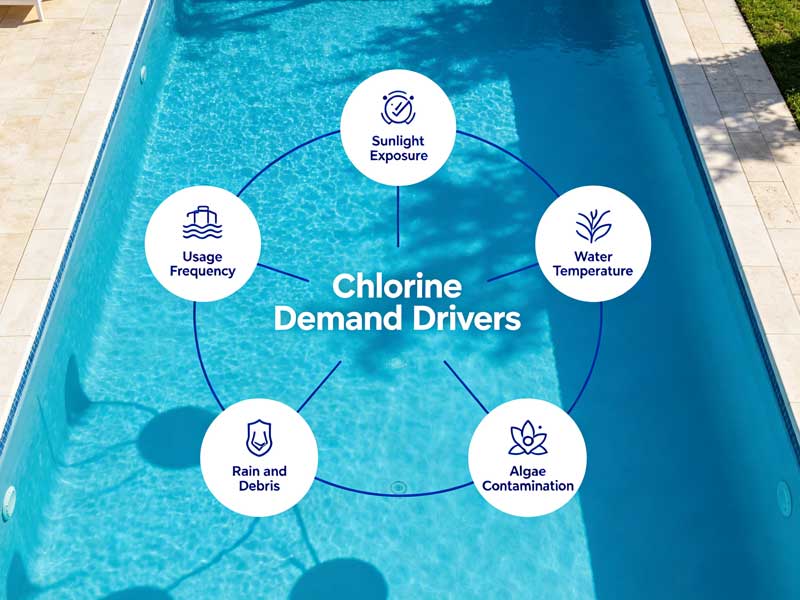
3. Water temperature
Warm water accelerates:
Bacterial growth
Chemical reactions
Pools in tropical climates usually require more frequent dosing.
4. Rain and debris
Rainwater and organic debris increase chlorine demand.
Leaves, dust, and pollen can quickly consume free chlorine.
5. Algae contamination
If algae begins to grow, chlorine demand increases dramatically.
In such cases:
Shock treatment is required
Additional Algaecide may also be used.
Best Practices for Adding Calcium Hypochlorite
To ensure safety and effectiveness, follow proper dosing procedures.
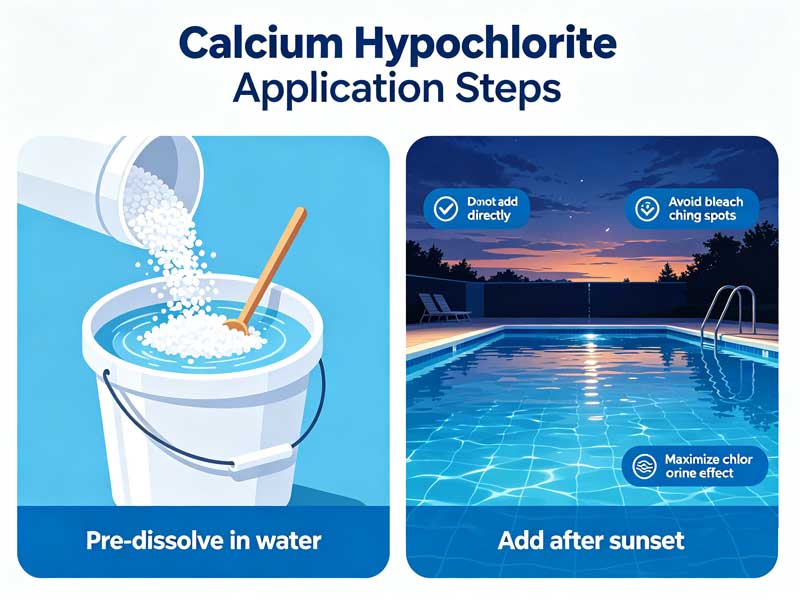
- Pre-dissolve before addingCalcium hypochlorite should be dissolved in a bucket of water before adding to the pool.This prevents:Bring insoluble calcium carbonate into pool waterBleaching of pool surfacesChemical concentration spots
- Add in the eveningChlorine is degraded by sunlight.Adding calcium hypochlorite in the evening or at night allows maximum effectiveness.
- Run the pool circulation systemEnsure the pump is running during and after dosing.Proper circulation distributes chlorine evenly throughout the pool.
- Avoid direct mixing with other chemicalsNever mix calcium hypochlorite with:AcidsOther oxidizersMixing chemicals can cause dangerous reactions.
- Retest water after treatmentAfter dosing:Wait 4–6 hoursRetest chlorine levelsAdjust dosage if necessary
Common Mistakes When Using Calcium Hypochlorite
Over-chlorination
Adding too much calcium hypochlorite may cause:
Skin irritation
Strong chlorine smell
Equipment corrosion
Ignoring pH levels
Chlorine efficiency is strongly influenced by pH.
Optimal pH range for pools: 7.2 – 7.6
If pH is too high, chlorine becomes less effective.
Poor storage practices
Calcium hypochlorite should be stored:
In cool, dry places
Away from organic materials
In sealed containers
Improper storage can cause loss of available chlorine or safety problems.
Advantages of Calcium Hypochlorite in Pool Treatment
High Chlorine Content: Compared to other disinfectants, calcium hypochlorite provides a higher effective chlorine content.
Strong Oxidizing Power: It effectively oxidizes:
Organic pollutants
Chloramines
Algae
Long Shelf Life: Compared to sodium hypochlorite, calcium hypochlorite remains stable for a longer period under proper storage.
Fast Dissolution and No Cyanuric Acid Production: No need to worry about excessive cyanuric acid causing chlorine lock-in. More suitable for Shock.
The amount of calcium hypochlorite to add to a swimming pool depends on several factors, including the pool's size, current chlorine levels, environmental conditions, and usage intensity.
By accurately calculating the dosage, monitoring water chemistry, and following proper application methods, pool operators can ensure clean, safe, and balanced pool water.
For professional pool chemical suppliers and distributors, providing high-quality calcium hypochlorite products along with appropriate technical guidance can significantly improve customer satisfaction and the long-term maintenance performance of the pool.
Post time: Mar-10-2026


