

‘Machine washable’ has become a key selling point for high-end wool products. Chlorinated anti-shrinkage agents such as TCCA (Trichloroisocyanuric Acid), SDIC (Sodium Dichloroisocyanurate / NaDCC), and CHC (Calcium Hypochlorite) offer wool textile manufacturers a unique technical solution thanks to their distinctive performance advantages.
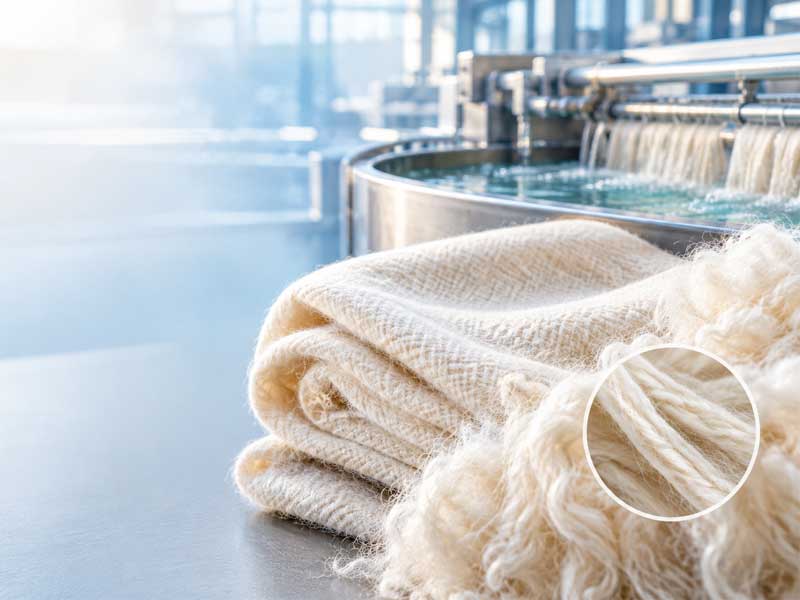
Why Does Wool Shrink?
There are several reasons why wool shrinks, such as its natural physical structure, water temperature, choice of detergent, and drying method.
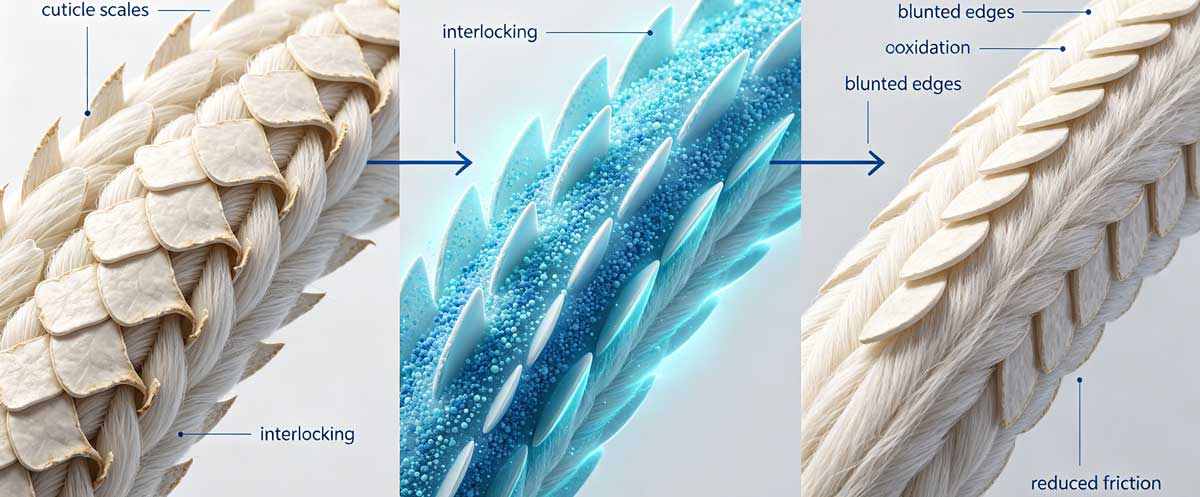
However, its natural structure is the primary cause. The surface of wool fibers is covered with unidirectional, hydrophobic scales. When wool comes into contact with water, the fibers draw closer together under the combined effects of mechanical action, heat, and surface tension, forming a dense structure. This interlocked state does not loosen after washing, resulting in garment shrinkage.
To produce machine-washable wool, textile finishing mills must modify the fiber surface structure and eliminate interlocking between the scale layers.
Mechanism of Action: How Chlorinated Oxidizing Agents Prevent Felting
Trichloro (TCCA), NaDCC (SDIC), and Calcium Hypochlorite (CHC) are all chlorine-containing oxidative finishing agents. Their core mechanism involves gently oxidizing or chlorinating the cuticle layer on the surface of wool, thereby smoothing scales and inhibiting felting.
By releasing active hypochlorous acid (HOCl), these agents achieve:
Oxidation of the surface keratin layer.
Breaking down the structure of the cuticle edges.
Reducing interlock between fibers to prevent shrinkage.
Does a higher level of available chlorine mean better results?
While available chlorine plays a crucial role in scale reduction, a higher concentration does not necessarily lead to better shrinkage prevention. Excessively rapid chlorine release can damage fiber tensile strength or create a harsh handfeel.
Key Factors Influencing Wool Treatment
When evaluating the effectiveness of wool shrinkage treatment, textile engineers must consider three key factors:
- Available Chlorine Content
- Solubility & Rate of Active Chlorine Release
- pH Level of the Aqueous Solution
Technical Comparison: TCCA vs. SDIC vs. Calcium Hypochlorite
Below is a comparison table outlining the chemical properties of our primary shrink-proofing products:
| Properties | Trichloroisocyanuric Acid (TCCA) | Sodium Dichloroisocyanurate (SDIC / NaDCC) | Calcium Hypochlorite (CHC) |
|---|---|---|---|
| Available Chlorine Content | 90% | 60% | 65% – 70% |
| Physical Form | White powder, granules, tablets | White powder, granules, tablets | White/light yellow powder, granules, tablets |
| pH of Aqueous Solution (1%) | 2.7 – 3.2 (Strongly Acidic) | 5.5 – 7.0 (Near-Neutral) | 10 – 12 (Strongly Alkaline) |
| Solubility in Water (25°C) | 1.2 g / 100 g | 25 g / 100 g | 27 g / 100 g |
(Note: All products supplied by Yuncang Chemical undergo strict quality control managed by our specialized chemical R&D team to ensure consistent batch performance.)
Detailed Performance Analysis
1. Available Chlorine Control
TCCA: The extremely high available chlorine (90%) can cause rapid reactions. It requires precise dosage control to avoid over-treatment and loss of wool strength.
SDIC (NaDCC): Provides a milder, highly controllable reaction, significantly reducing the risk of fiber damage.
CHC: Potent oxidizing capability, but chemically less stable in solution.
2. Solubility and Chlorine Release Rate
TCCA: Low solubility (1.2g/100g) means slow dissolution. Specialized equipment is recommended to assist dissolution and monitor residual chlorine.
SDIC: High solubility (25g/100g) enables fast, uniform solution generation, making it ideal for large-scale, automated textile treatment.
CHC: High calcium content makes it prone to precipitation under certain conditions, which may cause localized over-oxidation.
3. pH Adjustment Requirements
TCCA is strongly acidic, while CHC is strongly alkaline. Both require careful pH buffer adjustments prior to application.
SDIC forms a near-neutral solution (pH 5.5 – 7.0), minimizing the need for heavy pH adjustment buffers.
Application Scenarios for Textile Mills
TCCA & CHC Solutions: Best suited for coarse-spun wool products, large-volume/low-cost orders, and factories equipped with standard chemical dosing tanks.
SDIC (NaDCC) Solutions: Ideal for high-end worsted fabrics, premium knitwear, export-quality branded apparel, multi-variety/small-batch production, and highly automated dyeing mills.

Reliable Chemical Supply from Yuncang Chemical
Selecting the right chemical agent requires balancing performance, fiber safety, and supply chain reliability.
With over 30 years of manufacturing experience in chlorine-based chemical products, Yuncang Chemical provides:
- International Quality Certifications: Ensuring high purity, stable active chlorine content, and full compliance for export markets.
- Stable Supply Capacity: Long-term partnerships with raw material suppliers guarantee uninterrupted bulk deliveries for textile manufacturers worldwide.
- Technical Support: Tailored advice on dosage, pH control, and dissolution procedures.
Looking to enhance your textile anti-shrinkage process? Contact our technical team today for product specifications, MSDS, and competitive bulk pricing!
Post time: Sep-21-2026