


Slaughterhouse wastewater is among the most challenging industrial effluents to treat due to its high concentrations of suspended solids, proteins, fats, grease, blood residues, and organic matter. These contaminants contribute to elevated turbidity, chemical oxygen demand (COD), and biochemical oxygen demand (BOD), placing significant demands on coagulation and flocculation processes.
For many wastewater treatment plants, aluminum sulfate remains the primary coagulant because of its availability and relatively low unit price. However, treating complex slaughterhouse wastewater often requires high dosages, increasing chemical consumption, sludge production, and operating costs.
This case study presents the results achieved by an industrial poultry processor that evaluated our PDADMAC (PolyDiallyl Dimethyl Ammonium Chloride) product as part of its existing treatment program. We supplied the product together with application recommendations based on the customer’s operating conditions. The customer conducted plant trials and compared the performance with its conventional treatment process.
The results demonstrated that a lower treatment dosage could be achieved while reducing overall chemical expenditure, providing measurable economic benefits without compromising treatment performance.
Industry Background: High Pollutant Loading and Coagulants Demand
Wastewater generated during poultry and livestock processing contains a complex mixture of contaminants, including:
- Blood and soluble proteins
- Animal fats and grease
- Fine suspended solids
- Feather and tissue particles
- High concentrations of organic matter
- Variable pH and seasonal fluctuations
Compared with municipal wastewater, slaughterhouse wastewater generally exhibits significantly higher pollutant loading. As production volume changes throughout the day, wastewater characteristics may also fluctuate considerably, making consistent clarification more difficult.
Efficient coagulation is therefore essential for removing suspended solids before biological treatment or discharge. Selecting suitable treatment chemicals plays a major role in controlling operating costs while maintaining stable performance.
Customer Background: Seeking Cost-Effective Coagulants and Flocculants Solution
The customer is a large industrial poultry processing facility operating a dedicated wastewater treatment system.
Its treatment objective was straightforward:
- Maintain reliable clarification performance
- Reduce chemical consumption
- Lower monthly operating costs
- Improve overall treatment efficiency
Prior to evaluation, the facility relied primarily on aluminum sulfate for coagulation. Although the existing process consistently met production requirements, plant engineers observed that the required dosage remained relatively high, contributing to substantial monthly chemical expenses. The customer therefore began evaluating alternative coagulant aids capable of improving coagulation efficiency while reducing total chemical usage.
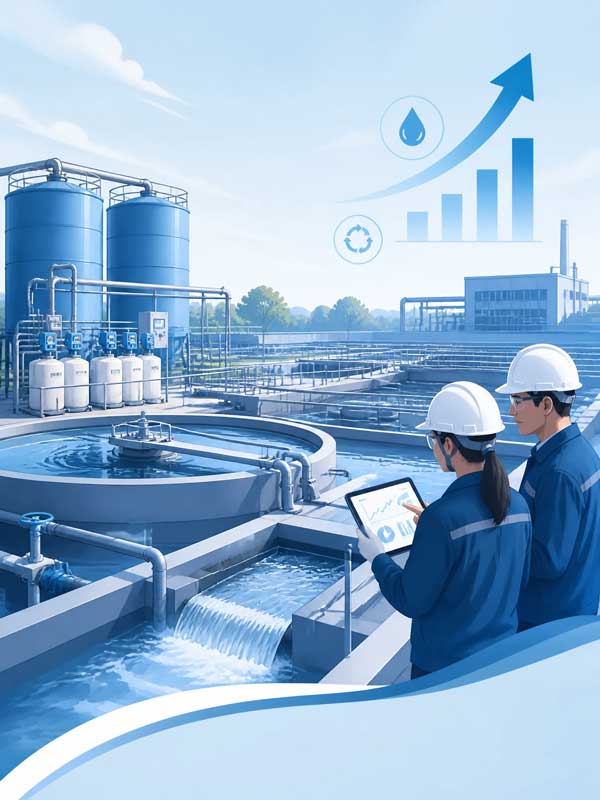
Existing Treatment Conditions with Traditional Aluminum Sulfate Coagulant
Before evaluating PDADMAC, the customer relied on aluminum sulfate as the primary coagulant for wastewater treatment. The average operating dosage was approximately 340 ppm, with a monthly chemical consumption of around 180 metric tons. This treatment program resulted in an estimated monthly chemical cost of approximately US$63,000.
Although the clarification performance met the plant's operational requirements, the relatively high dosage contributed to increased chemical consumption, higher sludge production, and rising operating costs. As a result, the customer began looking for opportunities to improve coagulation efficiency while reducing overall chemical usage.
PolyDADMAC Evaluation and Application Testing
After reviewing the customer’s wastewater characteristics and operating conditions, we supplied our PDADMAC product and provided application recommendations regarding dosage evaluation and trial procedures.
It is important to note that the wastewater treatment program, dosing strategy, and final process optimization were determined and validated by the customer during on-site trials. Our role was to provide consistent product quality and technical application guidance to support the evaluation process.
The objective of the trial was to determine whether PDADMAC could improve coagulation efficiency and reduce overall chemical consumption compared with the existing treatment program.
Plant Trial Implementation of PolyDADMAC Coagulant Aid
The customer conducted comparative trials under normal production conditions using identical wastewater streams. During the evaluation period, treatment performance was continuously monitored to ensure stable clarification while gradually adjusting the chemical dosage.
Key evaluation criteria included:
- Clarification performance
- Floc formation
- Settling characteristics
- Chemical consumption
- Operating cost
Rather than replacing the entire treatment process, the customer focused on determining whether optimized use of PDADMAC could improve coagulation efficiency and reduce the amount of chemicals required. The evaluation was carried out over multiple production cycles to ensure that the results represented actual operating conditions rather than short-term laboratory observations.
Trial Results: Significant Cost Savings and Dosage Reduction
After introducing PDADMAC (PolyDADMAC) into the coagulation process, the customer observed that the wastewater treatment system maintained stable clarification performance while operating at a significantly lower dosage. The average treatment dosage was reduced to approximately 200 ppm, and the estimated monthly chemical cost decreased to around US$52,000.
Compared with the original operating conditions, the optimized program reduced chemical dosage by approximately 41% and generated estimated monthly savings of approximately US$11,000. Based on continuous plant operation, this represents potential annual chemical cost savings of approximately US$132,000.
Performance Comparison: Aluminum Sulfate vs. PDADMAC Program
Following the plant evaluation, the customer confirmed that incorporating PDADMAC (PolyDADMAC) into the coagulation process improved treatment efficiency while significantly reducing chemical consumption.
Compared with the original treatment program, the required chemical dosage was reduced from 340 ppm to 200 ppm, representing an approximate 41% reduction. Monthly chemical expenditure also decreased from approximately US$63,000 to US$52,000, resulting in estimated monthly savings of around US$11,000 and potential annual savings of approximately US$132,000.
In addition to reducing operating costs, the customer observed more consistent floc formation and stable clarification performance throughout the evaluation period. These results demonstrate that, when properly applied, PDADMAC can enhance the performance of conventional coagulants, helping industrial wastewater treatment facilities improve process efficiency while lowering chemical consumption.
Although treatment performance depends on wastewater characteristics, operating conditions, and plant design, this case illustrates how high-charge-density PolyDADMAC can serve as an effective flocculant aid in slaughterhouse wastewater treatment applications.
Why PolyDADMAC Improved Treatment Efficiency
Slaughterhouse wastewater contains a high concentration of negatively charged colloidal particles, including proteins, fine organic matter, and emulsified fats. These particles are difficult to remove using traditional inorganic coagulants alone, especially when the wastewater composition fluctuates.
PolyDADMAC (PolyDiallyl Dimethyl Ammonium Chloride) is a high-charge-density cationic polymer that functions primarily through charge neutralization and particle destabilization.
In this application context, PDADMAC contributed to improved performance in several ways:
- Enhanced Charge Neutralization: The strong cationic nature of PDADMAC helps neutralize negatively charged suspended particles more effectively, reducing the demand for inorganic coagulants.
- Improved Floc Formation: Once destabilized, fine particles aggregate more rapidly into larger flocs, improving sedimentation efficiency and reducing turbidity.
- Faster Solid-Liquid Separation: Stronger and denser flocs settle more quickly, improving clarification performance in primary sedimentation units.
- Reduced Coagulant Demand: Because of improved destabilization efficiency, the system requires less aluminum sulfate to achieve similar clarification results.
- Better Process Stability: The polymer-assisted system provides improved tolerance against fluctuations in wastewater composition, which is common in slaughterhouse operations.

Additional Operational Benefits Observed with PDADMAC
Beyond chemical cost reduction, the customer also reported several secondary operational improvements during the evaluation period:
- More stable clarification performance during peak production cycles
- Improved sludge settling behavior
- Reduced variability in treated effluent turbidity
- Lower chemical handling intensity due to reduced dosage requirements
- Improved overall process controllability
These improvements contributed to smoother daily wastewater treatment operations and reduced operational stress on treatment personnel.
Key Takeaways for Wastewater Operators and Flocculant Suppliers
This evaluation highlights several important conclusions for industrial wastewater treatment operators:
- Slaughterhouse wastewater requires highly efficient coagulation strategies due to its complex composition
- High aluminum sulfate dosage does not always translate into optimal performance
- Polymer-based charge neutralization can significantly enhance coagulation efficiency
- Reducing chemical dosage is possible without major infrastructure changes
- Process optimization can generate substantial long-term cost savings
It is important to emphasize that results may vary depending on wastewater characteristics, system configuration, and operational conditions. Each facility should conduct its own evaluation to determine appropriate dosing strategies.

About Our PolyDADMAC: Trusted PolyDADMAC Suppliers
Our PDADMAC (PolyDiallyl Dimethyl Ammonium Chloride) is a high-performance cationic polymer designed for use in a wide range of industrial water treatment applications, including:
- Slaughterhouse and meat processing wastewater
- Food and beverage wastewater
- Paper and pulp effluents
- Textile wastewater treatment systems
- General industrial wastewater clarification processes
We supply PDADMAC in stable industrial grades suitable for continuous dosing systems and batch treatment applications.
We do not provide turnkey wastewater treatment systems or full process engineering services. Instead, we focus on supplying consistent-quality chemical products and offering application guidance based on customer-provided wastewater data and operational feedback. Final treatment design, process selection, and operational optimization remain the responsibility of the end user or their engineering partner.
Post time: Jul-03-2026


