


Key Regulatory Milestones for PFAS in France and the European Union
-
12 Jan 2021Directive (EU) 2020/2184 on the Quality of Water Intended for Human Consumption entered into force, introducing PFAS into the EU drinking water regulatory framework for the first time. The Directive established parametric values for both “PFAS Total” and “Sum of PFAS”, requiring Member States to incorporate PFAS monitoring into drinking water management.
-
12 Jan 2023EU Member States, including France, were required to transpose Directive (EU) 2020/2184 into national legislation, beginning the implementation of new PFAS monitoring and compliance requirements.
-
4 Apr 2024The French government launched the Interministerial PFAS Action Plan (2024–2027), setting out a nationwide strategy to strengthen PFAS monitoring, reduce industrial emissions, improve drinking water surveillance, accelerate scientific research, and enhance public transparency.
-
12 Jan 2026The PFAS parametric values established under Directive (EU) 2020/2184 become fully applicable across the European Union. Water suppliers are expected to comply with the mandatory limits for PFAS in drinking water, making pretreatment and advanced treatment optimization increasingly important.
Although technologies such as granular activated carbon (GAC), ion exchange, nanofiltration (NF), and reverse osmosis (RO) are widely used for PFAS reduction, their efficiency depends heavily on the quality of the incoming water. High concentrations of suspended solids, colloidal particles, turbidity, and natural organic matter (NOM) can accelerate membrane fouling, increase activated carbon loading, and raise operating costs.
In this context, effective coagulation and clarification have become increasingly important. PolyDADMAC should not be regarded as a chemical for direct PFAS removal. Instead, it serves as a high-charge cationic coagulant that enhances pretreatment by improving coagulation efficiency, reducing suspended solids, and creating more favorable operating conditions for downstream PFAS treatment technologies.
In This Article
In this article, you’ll learn:
- Why pretreatment is becoming increasingly important for PFAS treatment systems.
- How PolyDADMAC improves coagulation and clarification.
- How effective pretreatment supports activated carbon and membrane performance.
- Key considerations when selecting PolyDADMAC for municipal and industrial water treatment.
Why Efficient Pretreatment Is Essential for Modern Water Treatment
As water treatment standards continue to evolve, utilities are expected to remove not only conventional pollutants but also emerging contaminants while maintaining efficient and cost-effective operations. Advanced treatment technologies such as granular activated carbon (GAC), ion exchange, nanofiltration (NF), and reverse osmosis (RO) have become increasingly common, but their long-term performance depends heavily on effective pretreatment.
Poor pretreatment allows suspended solids, colloidal particles, turbidity, and natural organic matter (NOM) to enter downstream treatment systems. These impurities can accelerate membrane fouling, increase activated carbon loading, reduce process efficiency, and raise maintenance and operating costs.
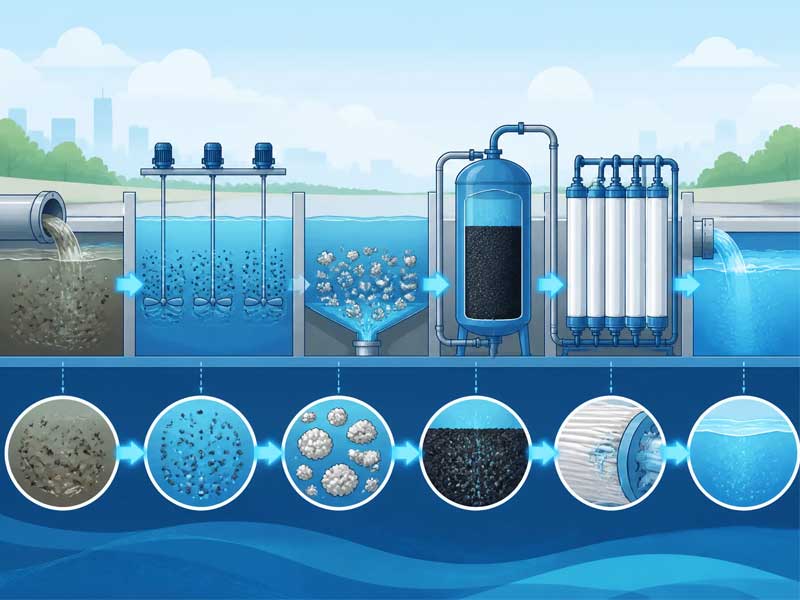
Effective coagulation and clarification help remove these non-target contaminants before advanced treatment begins. By improving water quality at the pretreatment stage, water plants can enhance the reliability and efficiency of downstream processes while extending the service life of treatment equipment.
For treatment systems addressing contaminants such as PFAS, pretreatment does not directly remove the target compounds, but it provides cleaner influent that helps advanced technologies operate more effectively and consistently.
How PolyDADMAC Improves Coagulation Performance
PolyDADMAC is a high-charge-density cationic polymer widely used as a primary coagulant or coagulant aid in drinking water and industrial water treatment. Unlike inorganic coagulants that rely mainly on metal salt hydrolysis, PolyDADMAC works primarily through charge neutralization, rapidly destabilizing negatively charged suspended particles and colloids to promote the formation of larger, denser flocs.
This enhanced floc formation improves solid-liquid separation during sedimentation and filtration, resulting in lower turbidity and reduced suspended solids in the treated water. By producing stronger and more compact flocs, PolyDADMAC can also improve clarification efficiency under varying raw water conditions, helping treatment plants maintain more stable performance.
In modern water treatment systems, efficient coagulation is more than a conventional pretreatment step—it lays the foundation for downstream processes. Cleaner influent entering advanced treatment units can help reduce unnecessary particle loading, improve operational stability, and support the overall efficiency of technologies such as activated carbon adsorption and membrane filtration.
Although PolyDADMAC is not designed to remove PFAS directly, its ability to optimize coagulation and clarification makes it a valuable pretreatment chemical in treatment trains where advanced PFAS removal technologies are employed. By improving the quality of water before it reaches these downstream processes, PolyDADMAC contributes to a more reliable and efficient overall treatment system.
Reducing Suspended Solids Before Advanced Treatment
Suspended solids are one of the primary factors affecting the performance of advanced water treatment processes. Fine particles, colloids, and other insoluble materials can pass through inadequate pretreatment, increasing the burden on downstream treatment units and leading to higher operating and maintenance costs.
By enhancing coagulation and floc formation, PolyDADMAC helps remove suspended solids more effectively during clarification and sedimentation. Larger, denser flocs settle more readily, resulting in clearer water entering subsequent treatment stages.
Reducing suspended solids before advanced treatment offers several operational benefits, including:
- Lower particulate loading on downstream treatment systems
- Improved clarification and filtration efficiency
- More stable operation under changing raw water conditions
- Reduced maintenance requirements for subsequent treatment processes
Although suspended solids are not PFAS, minimizing their presence during pretreatment creates more favorable operating conditions for advanced technologies such as activated carbon and membrane filtration. This allows these systems to focus on removing target contaminants rather than handling excessive particulate matter, helping improve overall treatment efficiency and operational reliability.
Supporting Activated Carbon Performance
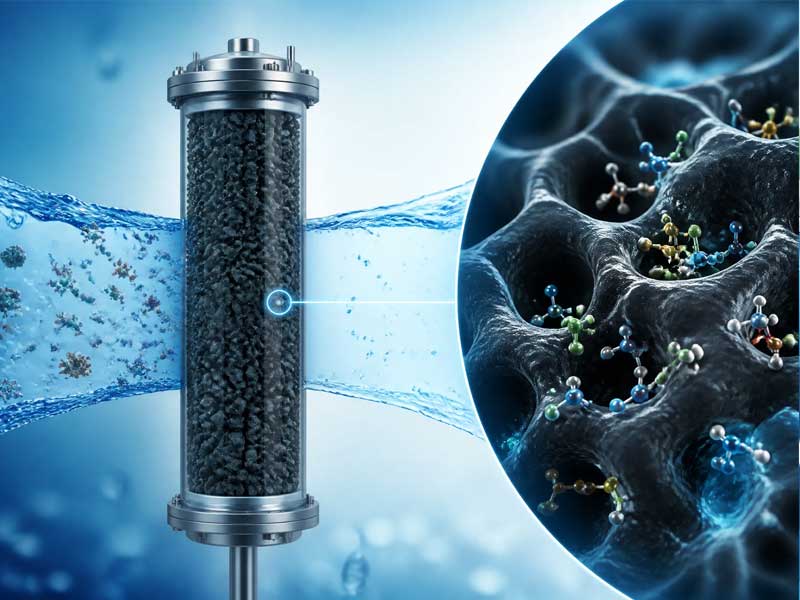
1. Granular activated carbon (GAC) is widely used in advanced water treatment for the removal of organic contaminants, including PFAS. GAC primarily removes PFASs by hydrophobic interactions, its performance can be affected by the quality of the influent water. High levels of suspended solids, colloidal particles, and natural organic matter (NOM) may occupy adsorption sites, increase head loss, and shorten the effective service life of the carbon bed.
The electrostatic interactions with polyDADMAC’s quaternary ammonium functional groups helped bind organic and inorganic ions as well as the headgroup of short-chain PFASs, allowing more overall PFAS removal by GAC. In that case, adsorption of anionic PFASs can be enhanced by the addition of cationic polymers such as poly diallyldimethylammonium chloride (polyDADMAC).
2. Effective pretreatment with PolyDADMAC helps improve coagulation and clarification, reducing the amount of particulate matter and organic load entering the GAC system. Cleaner influent allows activated carbon to operate under more stable conditions, helping maintain adsorption efficiency and reduce the frequency of backwashing or carbon replacement.
As part of a well-designed treatment train, optimized pretreatment can contribute to more reliable operation and improved cost efficiency of downstream GAC processes.
Reduce Membrane Fouling Through Better Clarification
Membrane technologies such as ultrafiltration (UF), nanofiltration (NF), and reverse osmosis (RO) are increasingly used in modern water treatment because of their high separation efficiency. However, membrane performance is highly dependent on effective pretreatment. Suspended solids, colloidal particles, and natural organic matter (NOM) that are not adequately removed can accumulate on membrane surfaces, leading to fouling, reduced permeate flux, and more frequent cleaning.
By improving coagulation and clarification, PolyDADMAC helps reduce the particulate load entering membrane systems. More effective removal of fine particles and colloids upstream contributes to cleaner influent, allowing membranes to operate under more stable conditions.
Although PolyDADMAC does not prevent membrane fouling directly, optimizing pretreatment can help lower the risk of particulate fouling, reduce cleaning frequency, and support longer operating cycles. As part of an integrated treatment process, effective clarification helps improve the overall efficiency and reliability of downstream membrane filtration systems.
PolyDADMAC Applications in Municipal and Industrial Water Treatment
PolyDADMAC is widely used in both municipal and industrial water treatment due to its high cationic charge density, rapid coagulation performance, and compatibility with a variety of treatment processes. It can be applied as a primary coagulant or as a coagulant aid to improve clarification efficiency under different raw water conditions.
In municipal drinking water treatment, PolyDADMAC is commonly used to reduce turbidity, suspended solids, and colloidal particles before filtration and disinfection. Effective pretreatment helps stabilize water quality and improves the performance of downstream treatment processes, particularly in surface water sources where seasonal fluctuations can significantly affect influent quality.
In industrial water treatment, PolyDADMAC is applied across a wide range of sectors, including food and beverage, pulp and paper, textile, chemical manufacturing, mining, and wastewater reuse. By improving solid-liquid separation and clarification efficiency, it helps optimize treatment performance while supporting more stable plant operation.
Key Considerations When Selecting PolyDADMAC
When evaluating PolyDADMAC for municipal or industrial water treatment, consider the following factors:
- Charge Density: Higher charge density generally provides stronger charge neutralization, making it suitable for waters with high concentrations of negatively charged colloids and suspended particles.
- Product Concentration: Liquid PolyDADMAC is available in different active contents. Selecting an appropriate concentration can help balance dosing accuracy, storage capacity, and transportation efficiency.
- Raw Water Quality: Parameters such as turbidity, suspended solids, natural organic matter (NOM), pH, and seasonal variations all influence coagulation performance and should be considered during product selection.
- Compatibility with Existing Treatment Processes: PolyDADMAC should be evaluated alongside existing coagulants, flocculants, dosing systems, and downstream treatment technologies to ensure stable process integration.
- Jar Testing and Pilot Trials: Laboratory jar tests and on-site pilot evaluations remain the most reliable methods for determining the optimal dosage and verifying treatment performance under actual operating conditions.
Selecting the right PolyDADMAC grade requires careful evaluation of your water quality, treatment objectives, and product specifications. If you’d like a more comprehensive overview of the key selection criteria, check out our related article: How to Choose the Right PolyDADMAC: A Practical Selection Guide. It covers important factors such as molecular weight, charge density, viscosity, active content, and application-specific recommendations.
Conclusion
Although PolyDADMAC is not designed to remove PFAS directly, it plays an important supporting role by improving coagulation and clarification, reducing suspended solids, and creating cleaner influent for downstream treatment systems. These benefits can help support activated carbon performance, reduce the risk of membrane fouling, and contribute to more stable and cost-effective plant operation.
As France and the European Union continue to strengthen PFAS regulations, water treatment plants are placing greater emphasis on improving the efficiency and reliability of their treatment processes. For municipal and industrial water utilities alike, optimizing pretreatment is becoming an essential strategy for meeting increasingly stringent water quality requirements. Selecting the appropriate PolyDADMAC and optimizing its application through proper testing can help maximize overall treatment efficiency and support the long-term performance of advanced water treatment processes.
References & Official Links:
- European Commission. Directive (EU) 2020/2184 on the Quality of Water Intended for Human Consumption (Recast). Website: EUR-Lex – Directive (EU) 2020/2184
- French Ministry for Ecological Transition. Interministerial Action Plan on PFAS (Plan d’action interministériel sur les PFAS). Website: French Government PFAS Action Plan
- PubMed: https://pubmed.ncbi.nlm.nih.gov/34861330/
Post time: Jul-09-2026


