

Polyacrylamide (PAM) is one of the most widely used flocculants in industrial water treatment. PAM plays a critical role in solid-liquid separation, sludge dewatering, and water clarification.
However, choosing the right type of PAM is not as simple as selecting a standard product. The wrong selection can lead to poor performance, increased costs, and operational inefficiencies. For distributors, importers, and industrial buyers, understanding how to choose the right PAM is essential for achieving optimal results.
In this guide, we'll break down the top 5 practical tips to help you select the most suitable Polyacrylamide for your industrial water treatment needs — while ensuring efficiency, cost-effectiveness, and compliance with modern environmental standards.
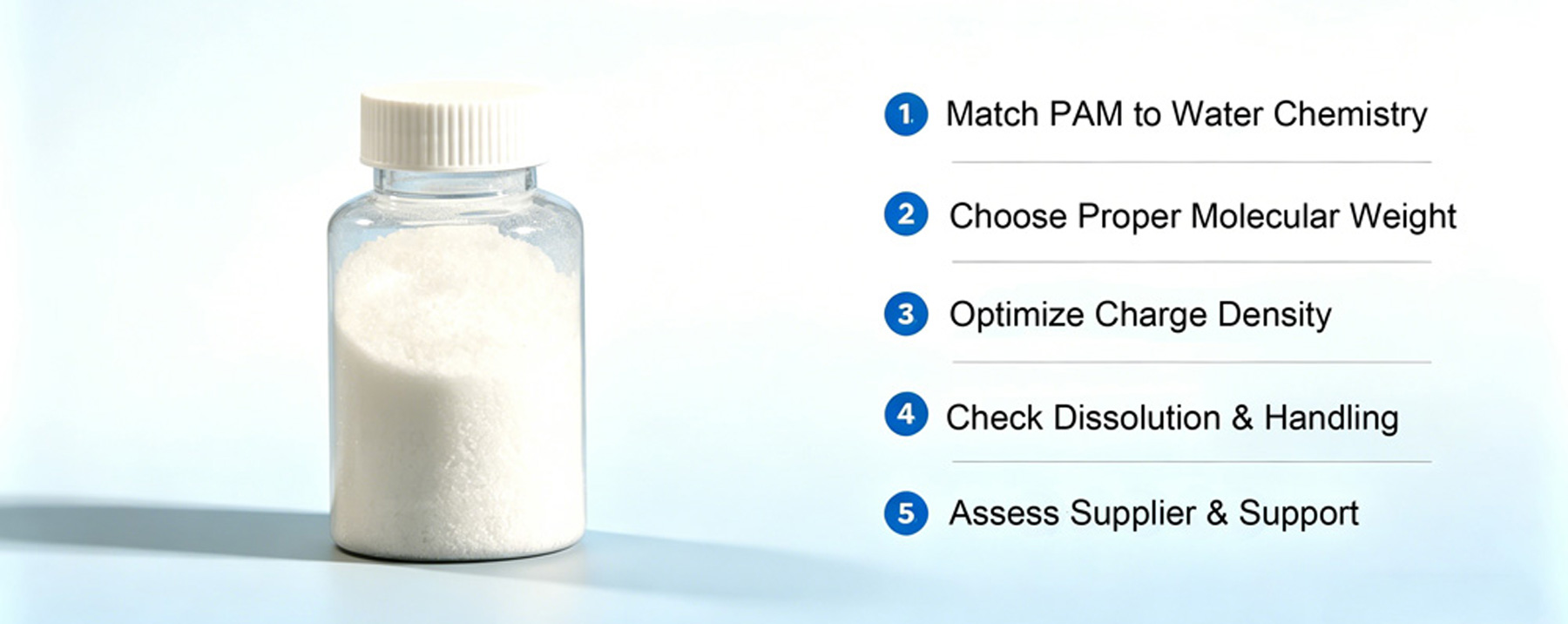
Polyacrylamide (PAM): A Quick Overview
Before diving into the selection tips, it’s important to understand what PAM is and how it works.
Polyacrylamide is a synthetic polymer formed from acrylamide monomers. It is mainly used as a flocculant or coagulant aid, helping fine suspended particles aggregate into larger flocs that can be easily removed.
Main Types of PAM:
- Anionic Polyacrylamide (APAM) – negatively charged
- Cationic Polyacrylamide (CPAM) – positively charged
- Nonionic Polyacrylamide (NPAM) – neutral charge
Each type is designed for different water chemistry conditions and treatment goals.
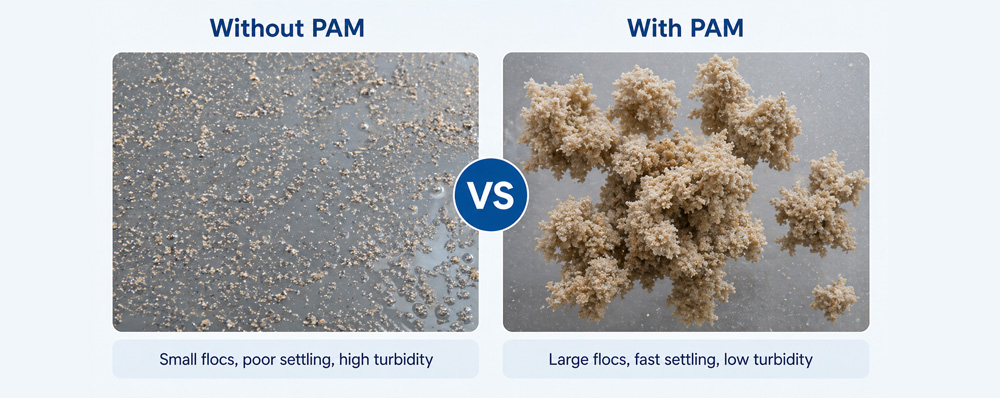
Tip 1: Match PAM Type with Water Chemistry
The most important factor when selecting PAM is the nature of the wastewater or process water.
Key Considerations:
- Suspended solids charge
- pH level
- Organic vs inorganic content
- Turbidity and particle size
General Selection Guidelines:
|
Water Type |
Recommended PAM |
| Inorganic wastewater (sand, clay) | Anionic PAM |
| Organic sludge (municipal, food processing) | Cationic PAM |
| Neutral or complex systems | Nonionic PAM |
If the charge of the PAM does not match the charge of the particles, flocculation efficiency will drop significantly. For example:
- Using APAM in organic sludge may result in weak floc formation
- Using CPAM in mineral wastewater can cause overdosing and cost waste
Pro Tip: Always conduct a jar test before large-scale application.
Tip 2: Select the Right Molecular Weight
Molecular weight determines how effectively PAM can bridge particles together.
| Type | Cationic PAM (CPAM) | Anionic PAM (APAM) | Nonionic PAM (NPAM) |
| Molecular Weight, (x106) | 6-15 | 5-26 | 3-12 |
Application Impact:
High molecular weight PAM
Strong bridging ability
Suitable for sludge dewatering
Produces larger, faster-settling flocs
Low molecular weight PAM
Better for dispersion
Suitable for fine particle systems
Selection Strategy:
For sludge dewatering → Choose high molecular weight CPAM
For clarification → Medium to high molecular weight APAM
For complex water systems → Start with medium molecular weight
Common Mistake:
Many buyers assume “higher molecular weight = better performance.”
In reality, overly high molecular weight can cause:
Poor solubility
Increased viscosity
Handling difficulties
Tip 3: Optimize Charge Density of PAM
Charge density (ionicity) is especially critical for cationic PAM (CPAM).
What is Charge Density?
It refers to the percentage of charged functional groups in the polymer.
| Type | Cationic PAM (CPAM) | Anionic PAM (APAM) | Nonionic PAM (NPAM) |
| Charge Density | 5-95 | 5-70 | 0-5 |
Application Guidelines:
|
Application |
Recommended Charge Density |
| Municipal sludge | Medium to high |
| Industrial organic sludge | High |
| Mixed wastewater | Medium |
Why It Matters:
Higher charge density improves neutralization of negatively charged particles
Too high → can cause restabilization or excessive chemical consumption
Too low → weak floc formation
Key Insight:
Charge density should be optimized together with molecular weight—not independently.
Tip 4: Consider Dissolution and Handling Performance
Even if the chemistry is correct, poor dissolution performance can ruin the application.
Important Factors:
Dissolution time
Water temperature
Mixing conditions
Powder vs emulsion form
Powder vs Emulsion PAM:
|
Form |
Advantages |
Disadvantages |
| Powder | Cost-effective, stable | Longer dissolution time; dissolving equipment is required |
| Emulsion | Fast dissolution | Higher cost, storage sensitivity, short storage life |
Best Practices:
Use clean water for dissolution
Maintain temperature between 20–40°C
Avoid high-speed mixing that can break polymer chains
Incomplete dissolution leads to:
Reduced flocculation efficiency
Blocked dosing systems
Increased operational costs
Tip 5: Evaluate Supplier Reliability and Technical Support
Choosing the right PAM is not just about the product—it’s also about the supplier.
What to Look For:
- Stable molecular weight and charge density
- Certified production (ISO, REACH, etc.)
- Ability to recommend suitable models
- Assistance with jar testing
- On-site or remote optimization guidance
- Adequate inventory
- Fast delivery capability
- Flexible packaging options
- Tailored PAM grades for specific industries
- Private labeling for distributors
Why It Matters:
- Inconsistent supply or quality fluctuations can:
- Disrupt plant operations
- Increase downtime
- Lead to compliance risks
For B2B buyers, working with a reliable manufacturer ensures long-term cost savings—not just short-term price advantages.
Additional Considerations for Industrial Buyer
1. Regulatory Compliance
Ensure PAM products meet:
- Local environmental regulations
- Drinking water standards (if applicable)
- Residual monomer limits
2. Application-Specific Requirements
Different industries have unique needs:
3. Cost vs Performance Balance
Instead, evaluate:
- Dosage requirements
- Sludge reduction efficiency
- Overall treatment cost per ton of water
Conclusion
Selecting the right Polyacrylamide (PAM) for industrial water treatment is a technical and strategic process. It requires a deep understanding of water chemistry, polymer characteristics, and operational conditions.
Key Takeaways:
- Match PAM type with wastewater characteristics
- Optimize molecular weight and charge density
- Ensure proper dissolution and handling
- Work with reliable, technically capable suppliers
- Always validate performance through testing
For distributors, importers, and industrial users, making the right PAM choice can lead to:
- Lower operating costs
- Improved treatment efficiency
- Enhanced environmental compliance
Post time: Apr-24-2026


