

Mining wastewater treatment is one of the most challenging aspects of industrial water management. Polyacrylamide (PAM), as a highly efficient flocculant, plays a crucial role in mining wastewater treatment. However, not all PAM products are suitable for mining wastewater treatment. Choosing the right type, molecular weight, charge density, and application method directly impacts treatment effectiveness, cost-effectiveness, and compliance with wastewater discharge standards.
This article will detail how to select the right PAM product for mining wastewater treatment needs, aiming to assist engineers, purchasing teams, and plant operators in making informed decisions.
Understanding the Characteristics of Mining Wastewater
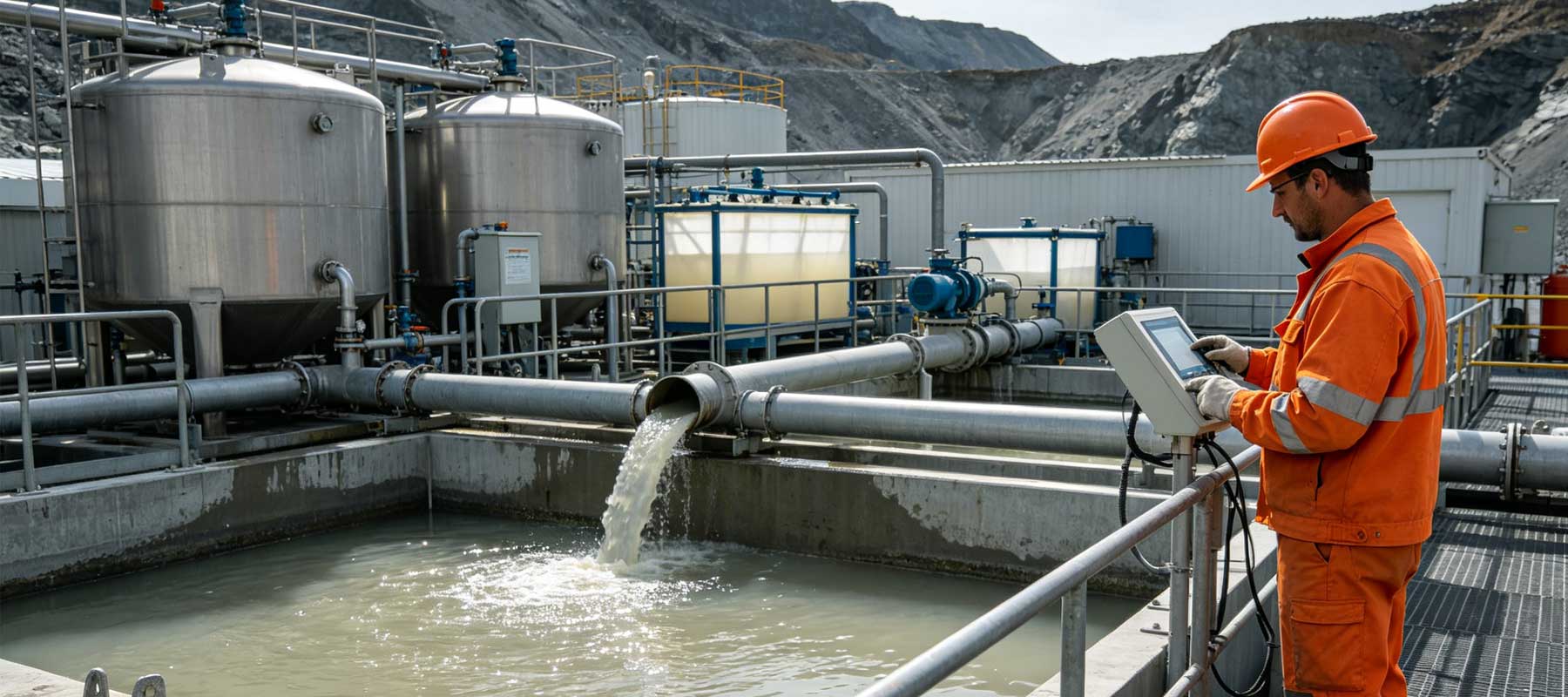
Mining wastewater often contains high concentrations of suspended solids, heavy metals, fine particles, and chemical residues. Understanding the properties of mining wastewater is essential before selecting PAM. Different mining operations generate different types of wastewater:
Common Sources of Mining Wastewater
- ▶ Coal mining and washing
- ▶ Metal ore mining (gold, copper, iron, zinc)
- ▶ Rare earth mining
- ▶ Quarrying and aggregate processing
- ▶ Tailorings discharge
Common Contaminants in Mining Wastewater
- ▶ Fine suspended solids (clay, silica, silt)
- ▶ Heavy metal ions (iron, copper, lead, zinc, manganese)
- ▶ High turbidity
- ▶ Acidic or alkaline pH conditions
- ▶ Organic and inorganic colloids
Challenges in Mining Wastewater Treatment
- ▶ Extremely fine particle size (difficult to settle naturally)
- ▶ Strong surface charge stability of colloids
- ▶ High sludge volume
- ▶ Variations in water quality across mining stages
Due to these factors, flocculation efficiency becomes crucial for treatment success, and polyacrylamide (PAM) is widely used as a core chemical.
The Role of Polyacrylamide in Mining Wastewater Treatment
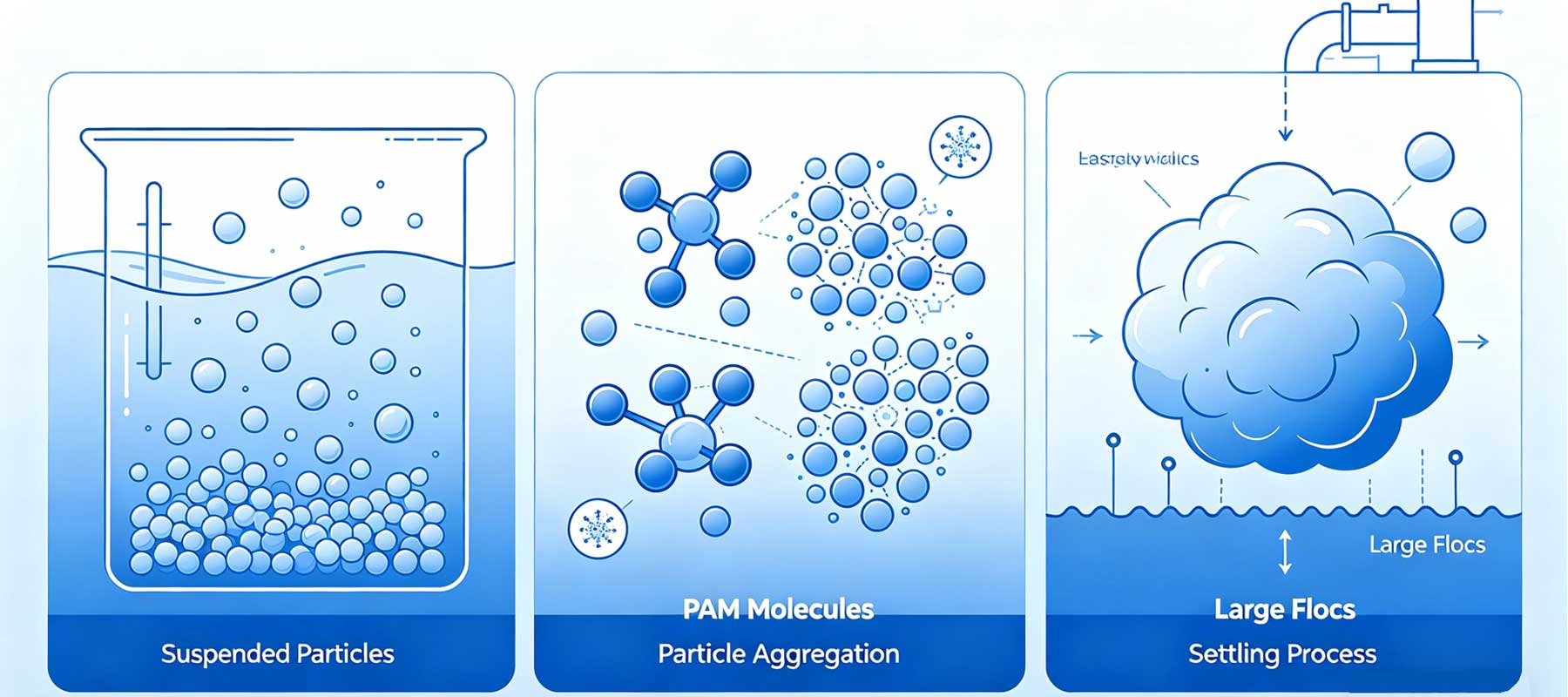
Polyacrylamide (PAM) is a water-soluble polymer used as a flocculant. It aggregates suspended particles into larger flocs, thereby accelerating sedimentation or filtration.
- ✓ Enhanced solid-liquid separation
- ✓ Increased settling velocity
- ✓ Reduced turbidity
- ✓ Assisted sludge dewatering
- ✓ Reduces chemical oxygen demand (COD) in some cases
Types of Polyacrylamide
PAM is typically classified into three categories:
Depending on the specific characteristics of the wastewater, the treatment efficacy of each type varies.
Key Factors for Choosing PAM in Mining Wastewater
Selecting PAM is not a one-time decision. The following factors must be carefully evaluated.
PAM Type (Charge Selection)
Anionic Polyacrylamide (PAM) is widely used in mining wastewater treatment because most mineral particles carry a positive charge—or a neutral surface charge—under acidic conditions, thereby enabling effective adsorption.
Best Suited For:
- Coal washing wastewater
- Metal ore beneficiation
- Tailings treatment
- High-turbidity water
Advantages:
- Strong bridging effect
- Rapid floc formation
- Cost-effective
Cationic polyacrylamide is rarely used in untreated mining wastewater, but it plays a crucial role in sludge treatment.
Best Suited For:
- Sludge dewatering in mining operations
- Wastewater containing negatively charged organic particles
Advantages:
- Strong charge neutralization
- Effective for sludge treatment
Non-ionic polyacrylamide is used in specialized situations where electrostatic interactions are minimal.
Best Suited For:
- Low-turbidity wastewater
- High-salinity systems
- Neutral pH environments
Molecular Weight Selection
Molecular weight determines the chain length of polyacrylamide (PAM) and directly influences the size of the flocs.
Low Molecular Weight
- Dissolves more rapidly
- Weaker floc-forming capability
- Rarely used for mining wastewater
- Balanced performance
- Suitable for water with moderate turbidity
High Molecular Weight
- Strong bridging effect
- Forms large, rapidly settling flocs
- Suitable for mining wastewater treatment
Recommendation:
For mining wastewater—due to the presence of fine, stable particles—high molecular weight polyacrylamide (PAM) is generally the preferred choice.
Charge Density
Charge density refers to the quantity of ionic charge present on a polymer chain.
Low Charge Density
- Suitable for lightly contaminated water
- Weak flocculation capability
Medium Charge Density
- Balanced performance
- Suitable for mixed wastewater conditions
High Charge Density
- Strong adsorption affinity for particles
- Best suited for treating high-concentration mining wastewater
Mining Wastewater Treatment Recommendations:
High Turbidity → High Charge Density Anionic Polyacrylamide
Mixed Systems → Medium Charge Density PAM
pH Conditions of Water
pH plays a crucial role in flocculation efficiency.
- Acidic wastewater (pH < 6): CPAM or NPAMperforms well.
- Neutral wastewater (pH 6–8): Both anionic and nonionic polyacrylamide can be used.
- Alkaline wastewater (pH > 8): Careful selection is required; anionic PAM is typically preferred, and dosage adjustments are necessary.
Due to ore processing, mining wastewater is often acidic, making anionic polyacrylamide the most common choice.
Particle Size Distribution of Suspended Particles in Wastewater
Smaller particle sizes make settling more difficult.
- Coarse particles: Low molecular weight polyacrylamide may suffice.
- Fine colloids: Require high molecular weight polyacrylamide.
- Ultrafine tailings: Require high charge density + optimized dosing system.
Sludge Characteristics in Mine Wastewater
If PAM is used for sludge dewatering:
- High organic sludge content: Cationic polyacrylamide is preferred
- Inorganic mineral sludge: Anionic polyacrylamide (PAM) is preferred
- Mixed sludge: Laboratory testing required
PAM Dosage Optimization
Even the best PAM will fail if the dosage is incorrect.
Insufficient dosage:
- Poor floc formation
- High effluent turbidity
Excessive dosage
- Particle restabilization
- Increased costs
- Sticky sludge
Best practice:
Always perform a jar test before full-scale application.
PAM Application Guide in Mine Wastewater Treatment
Correct usage is just as important as product selection.
Dissolution Determination
- Use clean water (avoid using water with high hardness)
- Concentration: 0.1%–0.5%
- Gently stir for 30–60 minutes
- Avoid high-speed stirring (to prevent polymer chain breakage)
Injection Point Selection
- Add polyacrylamide (PAM) after coagulants (e.g., polyaluminum chloride or ferric salts).
- Be sure to stir thoroughly before sedimentation.
Mixing Conditions
- Rapid Mixing Stage: Ensure uniform distribution
- Flocculation Stage: Low shear conditions required for floc growth
When Is PAC + PAM Combination Required in Mining Wastewater Treatment?
PAM Dosage Optimization
Features:
- High suspended solids concentration
- Numerous and fine particles
- Turbid color
Examples:
- Mining wastewater
- Tailings wastewater
- Sand and gravel aggregate wastewater
Treatment Logic:
- PAC first compresses the double electric layer, disrupting stability.
- PAM then performs bridging flocculation.
- This is the most typical combined application scenario.
High Proportion of Colloidal Particles
Characteristics:
- Extremely small particle size (<1 μm)
- Carries a stable negative charge
- Difficult to settle naturally
Examples:
- Wastewater from clay mines
- Wastewater from concentrate washing
Why is PAC needed:
- Increased costs
- Neutralization with PAC is necessary first
Highly Variable Water Quality
Characteristics:
- Large variations in pH and turbidity
- Unstable solids content
Examples:
- Mixed drainage from different mineral deposits
- Intermittent production wastewater
Reasons for combined use:
- PAC provides "basic stability"
- PAM adjusts floc structure
Fast Settling Requirement
Examples:
- Tailings thickener
- High-speed clarifier
Combined Use Advantages:
- PAC forms micro-flocs
- PAM forms macro-flocs
- Settling speed is significantly improved
Requirement for Downstream Water Reuse
Requirements:
- Lower turbidity
- Lower suspended solids (SS)
Examples:
- Industrial recycled water systems
- Mineral washing circulating water systems
Combined advantages:
- PAC removes fine particles
- PAM improves filtration efficiency
Contains Mixed Mineral System
Characteristics:
- Complex surface charge; Strong dispersion
Examples:
- Copper + iron ore mixed wastewater; Polymetallic tailings
Solutions:
- PAC (Polymerized Charge Environment); PAM (Polymerized Aggregator) to achieve structural aggregation
Conclusion
Selecting the appropriate PAM type for mining wastewater treatment is a technical decision that directly impacts treatment efficiency, operating costs, and environmental compliance. For most mining wastewater applications, high molecular weight anionic polyacrylamide remains the most widely used and effective choice, but the optimal selection should always be based on laboratory testing and field validation.
If you are dealing with slow sedimentation, high turbidity, or highly variable mining wastewater conditions, and seeking a dependable PAM supplier with consistent quality and technical support, Yuncang stands as your optimal choice.
We offer more than just chemicals; we provide customized flocculation solutions based on your specific water quality conditions. Whether you need to treat ultrafine tailings, wastewater with high sludge content, or systems with drastic pH fluctuations, our technical team can recommend the optimal PAC and PAM product models, dosages, and dosing strategies to ensure rapid sedimentation, clear water, and simplified subsequent sludge disposal processes.
With a stable supply and expert product understanding, we are committed to helping you achieve consistent and reliable wastewater treatment results, ensuring that every batch meets expected standards.
Contact us today to obtain PAM samples for your mining wastewater treatment needs, free beaker testing advice, and customized solutions.
Post time: May-06-2026


