

Polyacrylamide (PAM), as a highly effective water-soluble polymer flocculant, plays a crucial role in retention, filtration aid, and strength enhancement in the wet end of paper-making.
What is PAM?
Polyacrylamide (PAM) is a water-soluble polymer with excellent flocculation, thickening, dispersion, and bonding properties. It is widely used in industries such as water treatment, paper-making, mining, oil extraction, and textiles.
Depending on their ionic characteristics, PAM can be classified into anionic, cationic, non-ionic, and anionic types to meet different process requirements.
Why Are Retention Agents Necessary?
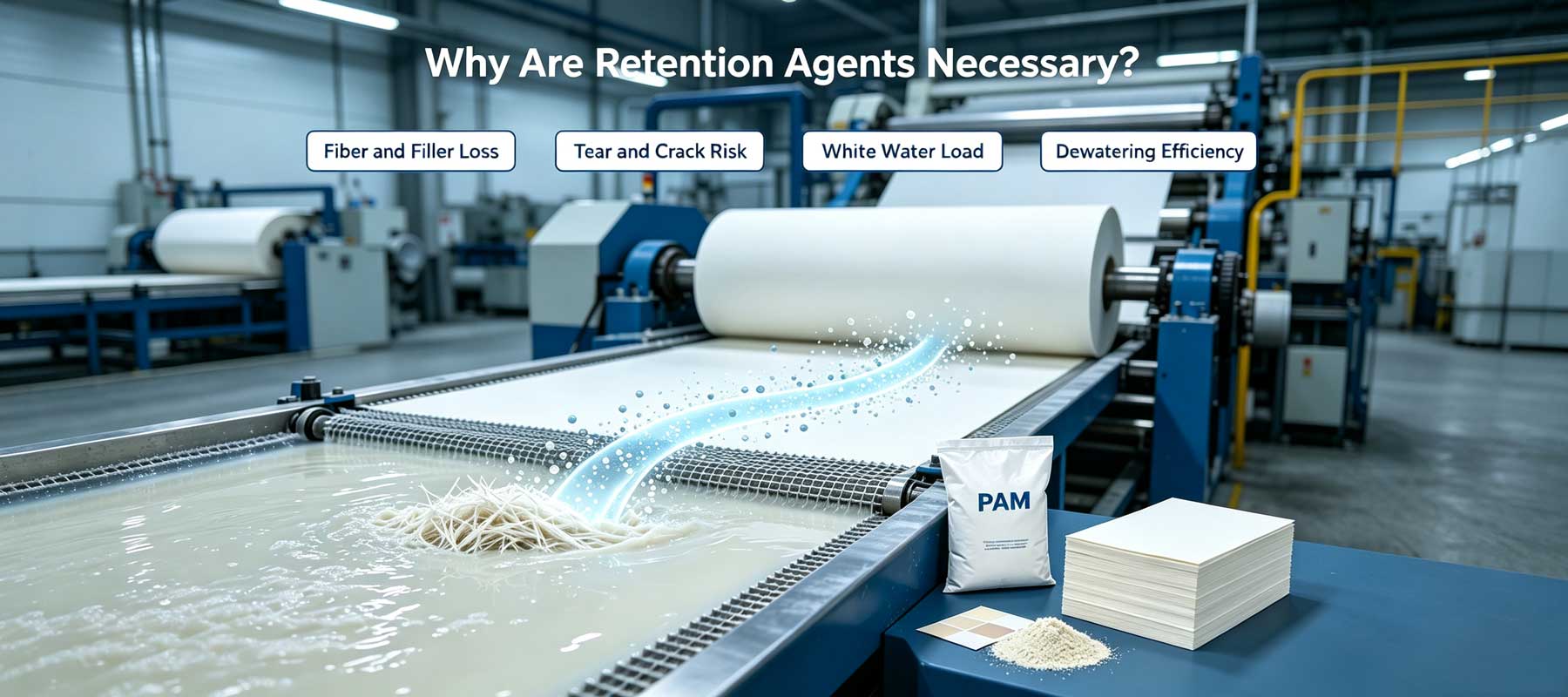
In the paper-making industry, failing to use retention agents leads to the following consequences:
- Significant loss of fine fibers and fillers, resulting in resource wasteDue to their small particle size and negatively charged surfaces, fine fibers (length < 0.2 mm) and filler particles in pulp cannot be retained in the paper sheet solely through mechanical retention. To maintain paper quality, additional fibers and fillers must be added, increasing costs.
- Reduced paper strength and uniformityThe absence of retention aids leads to the loss of fine fibers, reducing the components that bind long fibers together, resulting in paper that is prone to tearing and cracking.
- Increased white water system load and higher wastewater treatment costsLost fine fibers and fillers enter the white water recirculation system, leading to increased COD and SS levels in the wastewater.
- Reduced operational stabilityReduced dewatering efficiency of the paper machine, increased energy consumption, and reduced operational stability of the paper machine.
The Key Effects of PAM in Paper Flocculation
1 Improving the retention rate of fine fibers and fillers
Charge Neutralization: The ammonium or quaternary ammonium cationic groups on the CPAM molecular chains neutralize the negative charges on the surfaces of fibers and fillers, reducing electrostatic repulsion and reduce the thickness of the double layer, thereby facilitating particle aggregation.
Adsorption Bridging: The long polymer chains of CPAM can adsorb multiple particles simultaneously, connecting them like bridges to form large, loose flocs.
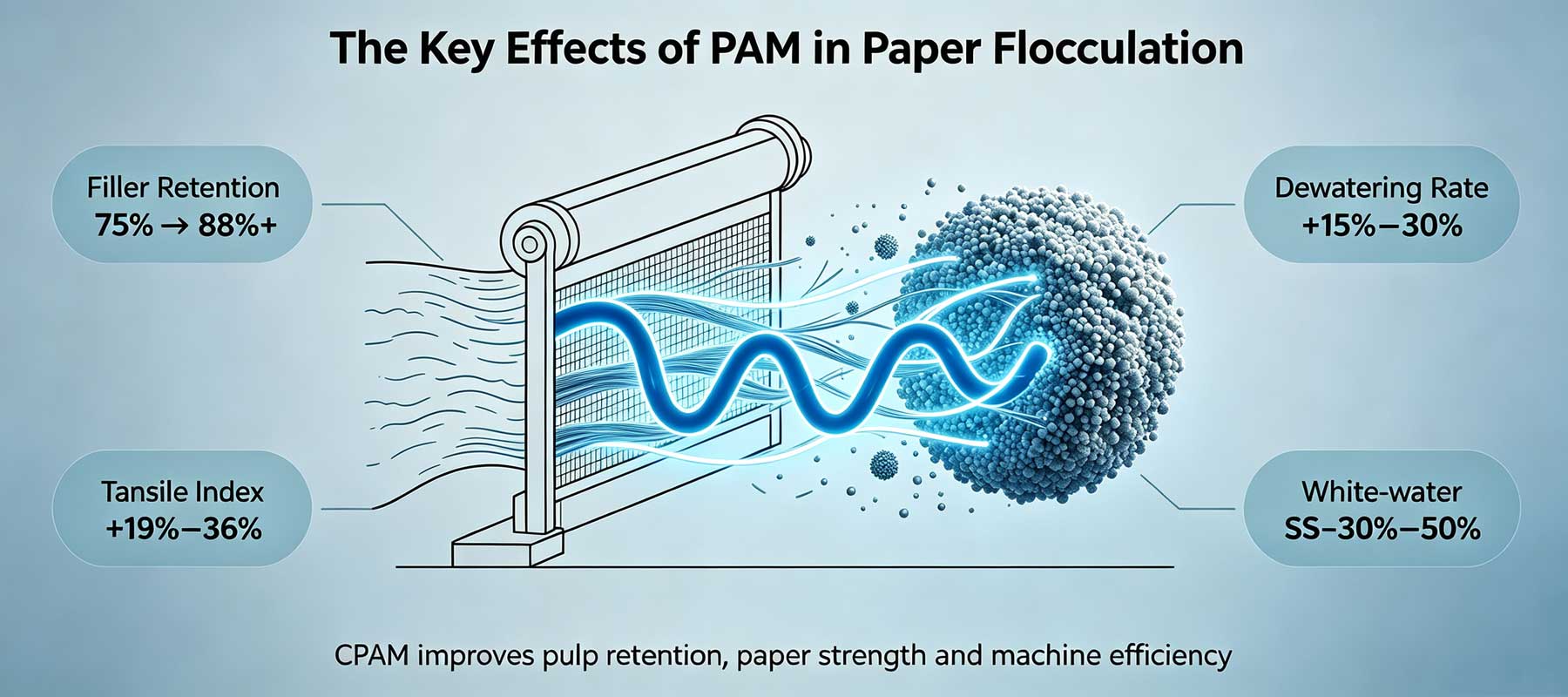
Practical applications demonstrate that in the production of cultural and printing papers, adding an appropriate amount of CPAM (typically 0.01%–0.05% based on absolutely dry pulp) can increase the retention rate of calcium carbonate or talc fillers from approximately 75% to over 88%, even 92%–95%. This improvement in retention rate directly reduces pulp consumption, significantly saving fiber costs per ton of paper.
2 Accelerating dewatering on the paper machine and reducing drying energy consumption
The floc structures formed by PAM are loose and highly permeable, facilitating rapid water removal in the wire and press sections. Compared to paper stock without PAM, dewatering rates can be increased by 15%–30%.
Faster dewatering means the paper sheet emerges from the press section with a higher dryness level, resulting in lower moisture content as it enters the drying section, thereby reducing steam consumption. Generally, paper machines using PAM can reduce energy consumption in the drying section by 10%–20%, leading to significant annual energy cost savings for large-scale machines.
3 Enhancing Dry and Wet Strength of Paper
The cationic groups on the CPAM molecular chains form hydrogen bonds and ionic bonds with the hydroxyl groups on the fiber surfaces, increasing the inter-fiber bonding strength and thereby improving the paper’s dry strength.
Tests show that adding an appropriate amount of CPAM can increase the paper’s tensile index by 19%–36%, with significant improvements in burst strength and tear resistance as well.
4 Improving Paper Uniformity and Surface Properties
Through flocculation, PAM ensures uniform distribution of fibers and fillers, reducing localized overcrowding or voids and improving the sheet’s uniformity index (typically by 10%–15%).
With improved uniformity, the paper’s smoothness, opacity, and print-ability are also enhanced, which is particularly significant for high-grade cultural paper and lightly coated paper.
5 Reducing White Water Concentration and Alleviating Environmental Pressure
PAM retention aids effectively reduce the content of fine fibers and fillers in white water, lowering white water concentration (suspended solids) by 30%–50%. This not only facilitates the recycling of white water and reduces the consumption of fresh water but also reduces the load on wastewater treatment plants, making it easier to meet discharge standards.
The following information will help you better understand this article:
What is wet-end chemistry in papermaking?
Wet-end chemistry is the study of how to achieve stable bonding between fibers, fillers, and chemical additives in the presence of large amounts of water, ultimately forming a high-quality paper sheet.
What are paper fillers, and why is it important to improve filler retention?
Fillers refer to inorganic mineral particles added to pulp. Fillers are significantly less expensive than fibers. Increasing filler retention can reduce costs and improve brightness, opacity, smoothness, and printability.
What is oven-dry pulp?
Oven-dry pulp (OD Pulp) is the standard method used in the paper industry to calculate chemical dosages: chemical dosages are calculated based on the weight of oven-dry pulp. Pulp concentration frequently fluctuates during papermaking. If calculations were based directly on wet pulp weight, varying moisture content would render the data incomparable.
Pulp concentration = 3%, total pulp volume = 10,000 kg; oven-dry pulp = 10,000 × 3% = 300 kg.
The recommended dosage of CPAM as a retention aid is 0.05% (0.05 kg of CPAM added to 100 kg of absolute dry pulp). Therefore, for 300 kg of absolute dry pulp, the dosage is 300 × 0.05% = 0.15 kg.
In summary, polyacrylamide offers comprehensive and multi-level benefits in paper flocculation. Please contact us if you have any needs. We will provide you with high-quality products and competitive prices.
Post time: Aug-05-2026


