

Why is it so difficult to treat paper mill wastewater?
Paper mill wastewater comes from a variety of sources, and the characteristics of wastewater generated by different production processes vary significantly.
Pulp and Paper Wastewater
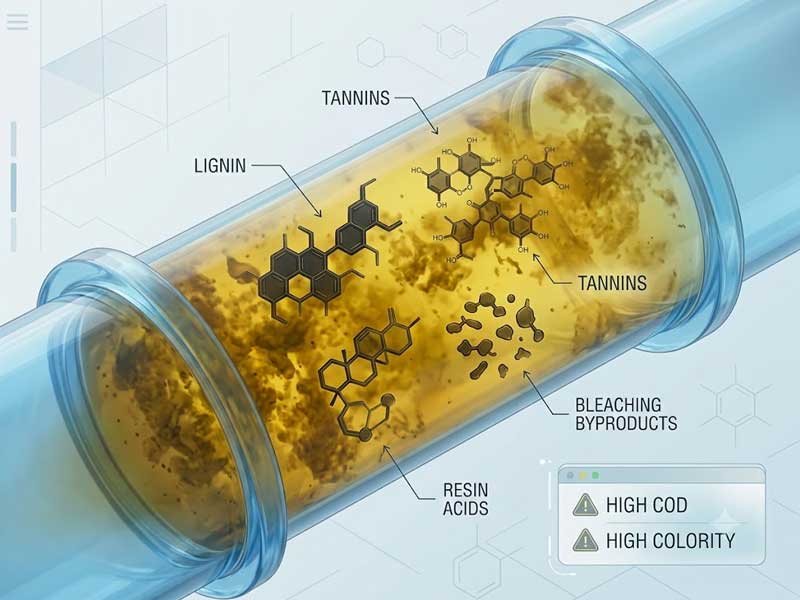
The pulp production process releases large amounts of lignin and its degradation products. The main pollutants include:
- Lignin
- Tannins
- Resin acids
- Bleaching byproducts
These substances cause the wastewater to appear deep yellow to brownish-yellow and result in a high COD.
Recycled Paper Mill Wastewater
Wastewater from waste paper recycling typically contains:
- Ink residues
- Adhesives
- Coating materials
- Filler particles
- Surfactants
It is characterized by high color intensity, strong colloidal stability, and difficulty in treatment.
Wastewater from dyed paper and specialty paper production
In addition to lignin, this type of wastewater may also contain direct dyes, acid dyes, or other organic colorants; therefore, decolorization is a key focus of the treatment process.
PAC: Preliminary wastewater treatment
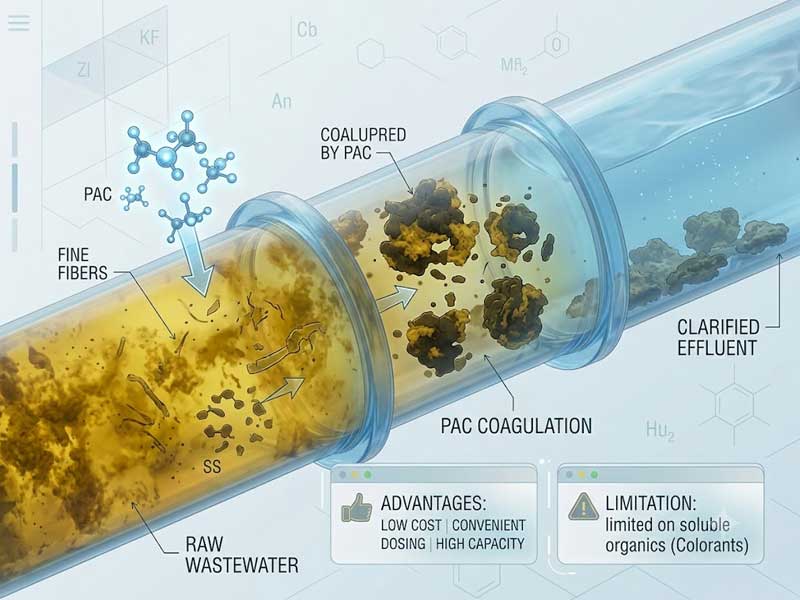
PAC (Poly Aluminium Chloride) is a highly effective inorganic coagulant widely used in industrial wastewater treatment. PAC is primarily responsible for removing:
- Suspended solids (SS)
- Fine fibers
- Filler particles
- Some lignin colloids
The advantages of PAC include:
- Low cost
- Convenient dosing
- High treatment capacity
- Strong adaptability
However, its treatment capacity is limited for soluble organic colorants, so PAC is often combined with other Industrial Wastewater Treatment Chemicals for advanced treatment.
Polyamine: Highly Effective Decolorization
Polyamine is a highly cationic polymeric decolorizing agent used in various wastewater treatment applications. Its molecular chains contain a large number of cationic groups, which can rapidly adsorb and neutralize negatively charged pollutants in wastewater.
How does polyamine achieve decolorization?
Many color-forming substances in paper mill wastewater carry a negative charge. Polyamine achieves decolorization through the following mechanisms:
- Charge neutralization: Neutralizes the negative charges on the surface of pollutants, causing them to lose stability.
- Adsorption bridging: Polymer chains link multiple pollutant particles together.
- Sedimentation: Forms larger flocs with color groups, which then settle.
Therefore, polyamine not only reduces color but also simultaneously removes a portion of the COD.
Key Advantages:
- High cationic charge density
- Good water solubility
- Wide pH applicability range
- High decolorization efficiency
- Fast flocculation rate
- Low dosage
PAM: Improving Settling Efficiency
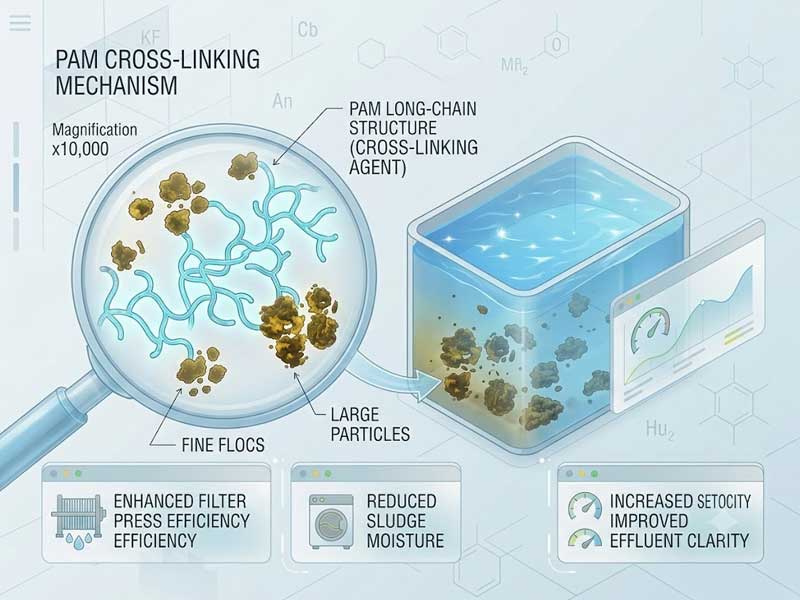
After treatment with PAC and polyamine, a large number of fine flocs have already formed in the wastewater. Adding PAM flocculant at this stage can further enhance the flocculation effect. The long-chain structure of PAM acts as a cross-linking agent, connecting dispersed flocs into larger particles. Its main advantages include:
- Increased settling velocity;
- Improved effluent clarity;
- Reduced sludge moisture content;
- Enhanced filter press efficiency.
Synergistic Treatment Mechanism of the Three Chemicals
- Reduction in color;
- Reduction in COD;
- Removal of suspended solids;
- Improved solid-liquid separation efficiency.
Advantages in Practical Applications
An increasing number of paper mills are opting for the combined PAC+Polyamine+PAM process, primarily due to the following advantages:
- Improved treatment efficiency: The synergistic action of these three chemicals enables more comprehensive removal of pollutants.
- Reduced operating costs: By optimizing the chemical combination, excessive dosing of individual chemicals can be minimized, thereby lowering overall operating expenses.
- Reduced Sludge Volume: Compared to relying solely on inorganic coagulants, the proper use of polyamine helps reduce sludge production.
- Improved Effluent Stability: Even when raw water quality fluctuates significantly, the combined process maintains relatively stable treatment results.
Suitable for Various Types of Paper Mill Wastewater
- Recycled paper wastewater;
- Wood pulp paper wastewater;
- Packaging paper wastewater;
- Whiteboard paper wastewater;
- Specialty paper wastewater;
- Dyed paper wastewater.
Typical Applications
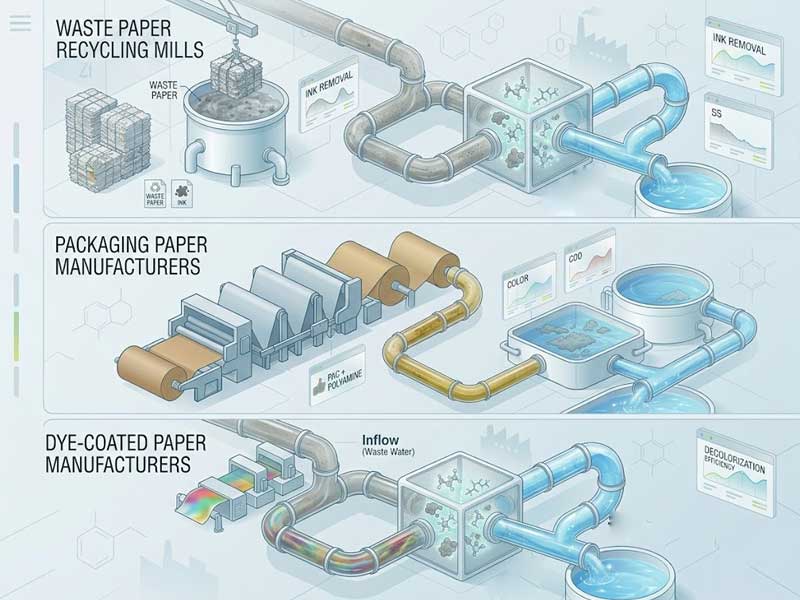
Waste Paper Recycling Mills
For wastewater from waste paper recycling with high ink content: PAC is used to remove suspended solids; polyamine is used to remove ink color complexes and anionic residues; and PAM promotes sedimentation. This typically results in a significant improvement in the appearance of the effluent.
Packaging Paper Manufacturers
Packaging paper wastewater typically contains high levels of lignin and fiber particles. The PAC + Polyamine combination effectively reduces color and COD loads.
Dye-Coated Paper Manufacturers
Dye residues are the primary issue in this type of wastewater. Polyamine demonstrates significant advantages as a decolorizing agent.
How to Optimize Chemical Dosage Performance?
Since the composition of wastewater varies significantly among different paper mills, it is recommended to conduct jar tests.
- Selection of PAC grade;
- Selection of polyamine cationicity;
- Selection of PAM ion type;
- Optimal dosing sequence;
- Optimal reaction pH.
The generally recommended dosing sequence is: PAC → Polyamine → PAM. This sequence helps maximize the benefits of each chemical.
Frequently Asked Questions (FAQ)
Can Polyamine treat paper mill wastewater on its own?
Yes, but the results are usually limited.
For wastewater with high color intensity, Polyamine can significantly remove color, but PAC and PAM are still needed in combination for suspended solids removal and sedimentation.
Is it better to add more PAC?
No.
Excessive PAC may lead to increased residual aluminum, which can even impair subsequent flocculation performance. When an excessive amount of PAC is added, a phenomenon known as restabilization occurs.
The optimal dosage should be determined through Jar testing.
Why must PAM be added last?
If added too early, first, the suspended particles in the untreated wastewater are too small, so PAM has little effect. Second, the long chains of PAM may be broken down by high-speed agitation and shear, impairing its cross-linking ability.
Therefore, it is typically added as the final chemical.
If you are interested in any of our PAC, polyamine, or PAM products, please feel free to contact us. We offer high-quality products at competitive prices.
Post time: Jul-29-2026


